
You Can Love Someone and Still Step Back: Healthy Boundaries Without Guilt
Our Blog
You Can Love Someone and Still Step Back: Healthy Boundaries Without Guilt

Healthy Boundaries Without Guilt: When Caring Becomes Carrying
When caring becomes carrying, it may be time to protect your own emotional and physical well-being. Learning to establish healthy boundaries without guilt allows you to love and support others without sacrificing your own peace, happiness, or health.
Have you ever loved someone deeply, recognized that they were struggling, and genuinely wanted to help but realized that continuing to be involved in their problems was taking a toll on your own health and happiness?
Perhaps this person is a family member, adult child, friend, romantic partner, or someone who has repeatedly turned to you for emotional support.
Establishing healthy boundaries without guilt doesn’t mean you love them any less. It means recognizing that your compassion, time, energy, and emotional resources have limits and that protecting your own well-being is just as important as caring for someone else.
You understand their struggles. You recognize their limitations. You may even believe they are doing the best they can with the emotional resources they have.
But understanding someone’s difficulties doesn’t mean you have unlimited capacity to accommodate them.
You can care about someone without being responsible for their happiness, choices, healing, or success.
Sometimes the healthiest and most loving decision is to step back, establish boundaries, reduce contact, or temporarily create more physical and emotional distance.
And you can do this without anger, resentment, punishment, or guilt.
When Two People Have Different Limitations
One of the most overlooked aspects of difficult relationships is that both people may be struggling with their own limitations.
One person may lack the emotional regulation, self-awareness, communication skills, or stability necessary to maintain a consistently healthy relationship.
They may genuinely need support but repeatedly create conflict, emotional demands, or crises that affect the people around them.
The other person may be compassionate, responsible, and willing to help—but already overwhelmed by work, family obligations, financial responsibilities, caregiving, personal challenges, or their own healing.
One person may lack the capacity to participate in a healthy relationship. The other may lack the capacity to continue compensating for that limitation.
Neither situation necessarily reflects a lack of love.
Sometimes the relationship simply requires more emotional resources than either person can currently provide.
Recognizing this can be incredibly freeing.
You don’t have to decide that someone is a bad person to recognize that continued involvement is not healthy for you.
The Difference Between Caring and Carrying
Compassionate people often become accustomed to taking responsibility for other people’s emotional well-being.
They may find themselves:
- Anticipating someone else’s emotional reactions
- Trying to prevent arguments, disappointment, or conflict
- Repeatedly offering solutions that are never implemented
- Feeling responsible when another person makes unhealthy decisions
- Sacrificing their own rest, relationships, or priorities
- Experiencing guilt when they don’t answer a call or respond immediately
- Feeling emotionally exhausted after spending time with someone
Over time, caring can gradually become carrying.
You may begin to feel that if you don’t intervene, something will go wrong – and somehow that outcome will be your responsibility.
But supporting another person is different from assuming responsibility for their life.
You can offer encouragement, information, resources, and appropriate assistance.
You cannot make another person develop emotional maturity, follow through with recommendations, change destructive patterns, or become ready for healing.
Those are processes that ultimately require their own participation.
Your Body May Recognize the Burden Before Your Mind Does
Emotional over-responsibility doesn’t always remain an abstract psychological experience.
Stress can influence muscle tension, breathing patterns, sleep quality, digestion, energy levels, and the body’s stress response.
You may notice:
- Tightness across your neck and shoulders
- Jaw clenching or tension headaches
- A heavy feeling in your chest
- Digestive discomfort before difficult interactions
- Fatigue after emotionally demanding conversations
- Difficulty relaxing because you’re anticipating the next crisis
- Anxiety or guilt when you try to prioritize yourself
For some people, these physical sensations become familiar signals that their emotional resources are being stretched beyond their limits.
The shoulders may feel as though they’re carrying the weight of everyone else’s problems.
The throat may tighten when you need to say no, express your needs, or communicate a difficult boundary.
The stomach may become unsettled when you’re anticipating conflict.
These sensations don’t necessarily identify the cause of stress, but they can provide useful opportunities to pause, notice your emotional state, and evaluate what you need.
Your body deserves care and consideration, too.
Recognizing When It’s Time to Step Back
You don’t have to wait until you’re angry, resentful, physically exhausted, or emotionally depleted before establishing boundaries.
Consider asking yourself:
- Am I helping because I genuinely have the capacity, or because I feel guilty saying no?
- Does this relationship regularly leave me feeling anxious, depleted, or overwhelmed?
- Am I assuming responsibility for choices that belong to someone else?
- Have I clearly communicated my needs and limitations?
- Is my involvement actually helping, or are we repeating the same patterns?
- What would happen if I allowed this person to take more responsibility for their own decisions?
- What level of contact can I realistically maintain without sacrificing my well-being?
Sometimes the answer isn’t ending a relationship.
It may simply mean changing how you participate in it.
Low Contact, Less In-Person Contact, and Temporary Distance
Healthy boundaries aren’t always all-or-nothing.
Depending on the circumstances, you might choose to:
- Limit telephone conversations to certain times or durations.
- Communicate through text rather than emotionally intense in-person conversations.
- Reduce visits temporarily while you attend to your own responsibilities.
- Decline to participate in repeated arguments or emotionally charged discussions.
- Offer specific assistance without becoming responsible for managing an entire situation.
- Take a temporary break from contact when interactions become overwhelming.
- Reevaluate your availability as your circumstances and emotional resources change.
A simple boundary might sound like:
“I care about you, and I understand that you’re having a difficult time. I have a lot on my plate right now, and I don’t have the emotional capacity to help in the way I have before. I need to step back for a while.”
You don’t need to provide an elaborate explanation or persuade someone that your boundary is reasonable.
A boundary describes what you are willing and able to do. It doesn’t require controlling the other person’s response.
When someone depends on you for essential care or safety, stepping back may also require arranging appropriate alternative support.
Creating distance isn’t necessarily rejection. Sometimes it is the adjustment that makes continued compassion possible.
Releasing the Guilt of Not Doing Enough
For people who have spent years being dependable, responsible, nurturing, or emotionally available, setting boundaries may initially feel uncomfortable.
You may experience thoughts such as:
- What if they need me?
- What if something goes wrong?
- Am I being selfish?
- Shouldn’t I be doing more?
- What if they think I don’t care?
These thoughts can be especially powerful when someone you love has genuine difficulties. But guilt is not always evidence that you’re doing something wrong. Sometimes guilt is simply the discomfort of changing a familiar pattern.
You may have learned to associate being a good parent, spouse, friend, or family member with being endlessly available. Learning to establish healthier boundaries may require gently challenging that belief.
You are responsible for your own choices, compassion, and integrity, not for another person’s willingness or ability to change.
You can wish someone well without accompanying them through every crisis.
You can hope for their healing without making their healing your personal assignment.
You can love someone and still choose peace.
EFT Tapping for Guilt, Emotional Responsibility, and Boundaries
Emotional Freedom Techniques (EFT), commonly called tapping, combines gentle tapping on specific points with focused statements about thoughts and emotions.
Some research suggests EFT may help reduce perceived stress and anxiety, although the evidence is still developing.
EFT can be used as a complementary self-regulation practice when guilt, fear, or emotional over-responsibility makes boundary-setting difficult.
A Simple EFT Tapping Exercise
Begin by identifying the feeling you want to address.
Perhaps it’s guilt about not answering someone’s calls, anxiety about disappointing them, or fear that something bad will happen if you stop helping.
Rate the emotional intensity from 0 to 10.
Gently tap on the side of your hand while repeating:
“Even though I feel guilty stepping back because I care about this person, I acknowledge my feelings and choose to honor my own needs.”
Repeat three times.
Then gently tap through the following points while using the suggested reminder phrases:
Eyebrow: “I feel responsible for their well-being.”
Side of eye: “I don’t want to let them down.”
Under eye: “I’m carrying so much responsibility.”
Under nose: “Part of me believes I should do more.”
Chin: “But I have needs and limitations, too.”
Collarbone: “I can care without carrying everything.”
Under arm: “I give myself permission to establish healthy boundaries.”
Top of head: “I choose compassion for them and compassion for myself.”
Take a slow, comfortable breath.
Notice whether the intensity of the feeling has shifted.
You can repeat the sequence, adjusting the statements to reflect your personal experience.
For some people, the deeper emotional work involves identifying long-standing beliefs about responsibility, self-worth, conflict, or the need to be needed.
These are areas that can be explored through individualized EFT sessions and holistic emotional wellness consultations.
Aromatherapy for Emotional Support, Courage, and Clarity
Aromatherapy can be a comforting addition to a boundary-setting and stress-management routine.
Essential oils may provide pleasant sensory experiences that support relaxation and mindful self-care. Responses vary, and aromatherapy should be viewed as a complementary wellness practice rather than a treatment for underlying mental health conditions.
Two BioSource Naturals body lotions are particularly relevant to the emotional themes of boundaries and over-responsibility.
Courage & Clarity Body Lotion: Finding the Confidence to Honor Your Boundaries
Courage & Clarity Body Lotion can become part of an intentional self-care ritual when you’re struggling with self-doubt, guilt, or the fear of disappointing others.
Within traditional chakra-based wellness practices, the solar plexus chakra is associated with personal power, self-confidence, autonomy, and the ability to make decisions that reflect your own needs and values.
These are symbolic associations rather than established anatomical or medical mechanisms.
As you apply Courage & Clarity Lotion, take a moment to breathe and reflect on the following affirmation:
“I trust myself to make healthy decisions. I can be compassionate without sacrificing my peace. My needs matter, too.”
Use this moment to reconnect with your own sense of direction.
Sometimes courage isn’t about confronting someone or making a dramatic change.
Sometimes courage is quietly deciding that you will no longer abandon your own needs to maintain someone else’s comfort.
Stress Relief Body Lotion: When You’re Carrying Too Much
BioSource Naturals Stress Relief Body Lotion is a natural fit for people who feel burdened by excessive responsibilities.
Stress frequently contributes to tension in the neck, shoulders, and upper back.
Within traditional chakra practices, the throat chakra is associated with communication, personal expression, and speaking one’s truth.
When you’re constantly accommodating others, you may find it difficult to express your limitations or say what you genuinely need.
Consider incorporating Stress Relief Lotion into a gentle neck-and-shoulder self-massage, following the product’s directions.
As you massage the area, take several slow breaths and repeat:
“I release responsibilities that are not mine to carry. I am allowed to rest. I can communicate my needs with kindness and confidence.”
This simple ritual combines touch, aroma, breathing, and mindful intention.
It creates an opportunity to pause and acknowledge how much you’ve been carrying.
The lotion does not resolve the underlying relationship difficulties, but the ritual can serve as a meaningful reminder to care for yourself.
Mind-Body Healing: Regulate, Release & Repattern, Recognize, Restore
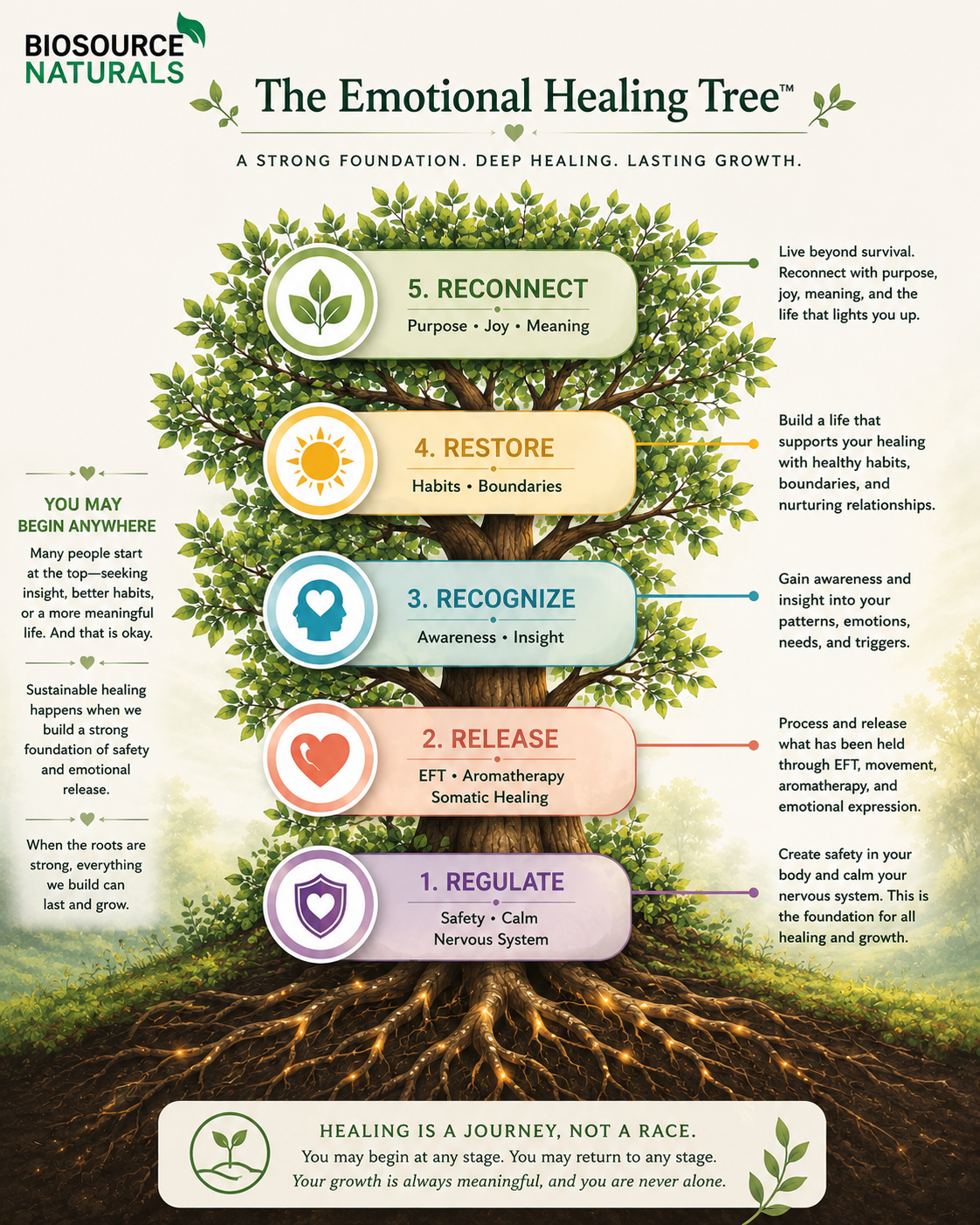
Click to Enlarge and Read
At Holistic Healing & Wellness, emotional well-being is approached through an individualized, whole-person perspective.
Mind-Body Healing: The Emotional Healing Tree™ and Healthy Boundaries
Establishing healthy boundaries involves more than learning to say no. It often requires recognizing long-standing emotional patterns, calming the nervous system, releasing guilt and excessive responsibility, and developing healthier ways of relating to yourself and others.
At Holistic Healing & Wellness, The Emotional Healing Tree™ provides a five-stage framework for emotional healing, personal growth, and lasting change.
Just as a tree needs strong roots to support healthy growth, emotional well-being begins with a foundation of safety and self-awareness.
1. REGULATE — Safety, Calm & Nervous System Support
Before making difficult relationship decisions, it’s helpful to calm your body’s stress response.
When you’re overwhelmed by someone else’s problems, your nervous system may remain on high alert, contributing to anxiety, muscle tension, fatigue, and difficulty thinking clearly.
Breathing exercises, grounding techniques, EFT tapping, aromatherapy, and relaxation practices can help you feel calmer and more centered.
The goal: Create enough emotional and physical calm to respond thoughtfully rather than react from guilt, fear, or obligation.
2. RELEASE — Letting Go of Guilt and Emotional Burdens
Many compassionate people carry responsibilities that were never truly theirs.
You may feel guilty about stepping back, fearful of disappointing someone, or responsible for another person’s happiness and success.
Through EFT tapping, aromatherapy, somatic practices, and emotional expression, you can begin exploring and releasing the emotional patterns that contribute to over-responsibility.
BioSource Naturals Stress Relief Body Lotion can complement this process as part of a calming neck-and-shoulder self-massage ritual, particularly when you’re feeling weighed down by excessive responsibilities.
The goal: Release the belief that loving someone means carrying their burdens or sacrificing your own well-being.
3. RECOGNIZE — Awareness, Insight & Understanding Your Patterns
Emotional healing involves understanding why certain relationships, situations, or requests trigger guilt, anxiety, or an overwhelming sense of responsibility.
Perhaps you’ve always been the dependable one, the peacemaker, the caregiver, or the person everyone turns to during a crisis.
Recognizing these patterns helps you distinguish between genuine compassion and learned emotional obligations.
You may also begin to recognize that someone you love lacks the capacity for a consistently healthy relationship—and that you currently lack the capacity to compensate for their limitations.
The goal: Develop the clarity to recognize what belongs to you, what belongs to someone else, and what you realistically have the capacity to give.
4. RESTORE — Healthy Habits, Boundaries & Relationships
With greater emotional awareness, you can begin creating healthier relationship patterns and daily habits.
This may involve communicating your needs, reducing contact, limiting emotionally exhausting conversations, or allowing others to take greater responsibility for their own choices.
It also means restoring your own physical and emotional resources through nutrition, rest, self-care, supportive relationships, and meaningful activities.
BioSource Naturals Courage & Clarity Body Lotion can be incorporated into a personal intention-setting ritual. Within traditional chakra practices, the solar plexus chakra symbolizes confidence, personal power, and healthy boundaries.
The goal: Build a life that supports your well-being rather than continually depleting it.
5. RECONNECT — Purpose, Joy & Meaning
When you’re no longer consumed by managing someone else’s problems, you create space to reconnect with yourself.
You may rediscover interests you’ve neglected, relationships that nurture you, personal goals, spiritual connections, and activities that bring joy and meaning into your life.
You can continue loving someone without allowing their struggles to define your daily emotional experience.
The goal: Move beyond simply coping with difficult relationships and begin living a life that reflects your own values, needs, and purpose.
Healing Is a Journey, Not a Race
The Emotional Healing Tree™ is not a rigid, step-by-step process. You may begin at any stage and revisit different stages as your circumstances change.
Sometimes establishing a boundary begins with recognizing an unhealthy pattern. Other times, you may first need to regulate your nervous system or release the guilt associated with stepping back.
Each stage supports the others, helping you develop a stronger foundation for emotional well-being and personal growth.
**You can love someone, wish them
The goal isn’t to become less loving.
It’s to develop a healthier relationship with responsibility, compassion, and your own well-being.
You Don’t Have to Stop Loving Someone to Stop Participating in Unhealthy Patterns
One of the most liberating realizations in emotional healing is that caring about someone doesn’t obligate you to remain involved in every aspect of their life.
You can acknowledge their pain without making it your responsibility to resolve.
You can respect their limitations while honoring your own.
You can hope they find stability, happiness, and healing while recognizing that you cannot create those outcomes for them.
And you can step back without needing to stop loving them.
You didn’t stop caring. You stopped participating in a pattern that was no longer healthy for you.
Sometimes protecting your peace is the healthiest choice you can make—for yourself and for the relationship.
Need Help Establishing Healthy Boundaries Without Guilt?
Click to Enlarge and Read
If you’re feeling overwhelmed by family responsibilities, difficult relationships, caregiving demands, emotional exhaustion, or the guilt of stepping back, individualized holistic support may help you explore healthier ways forward.
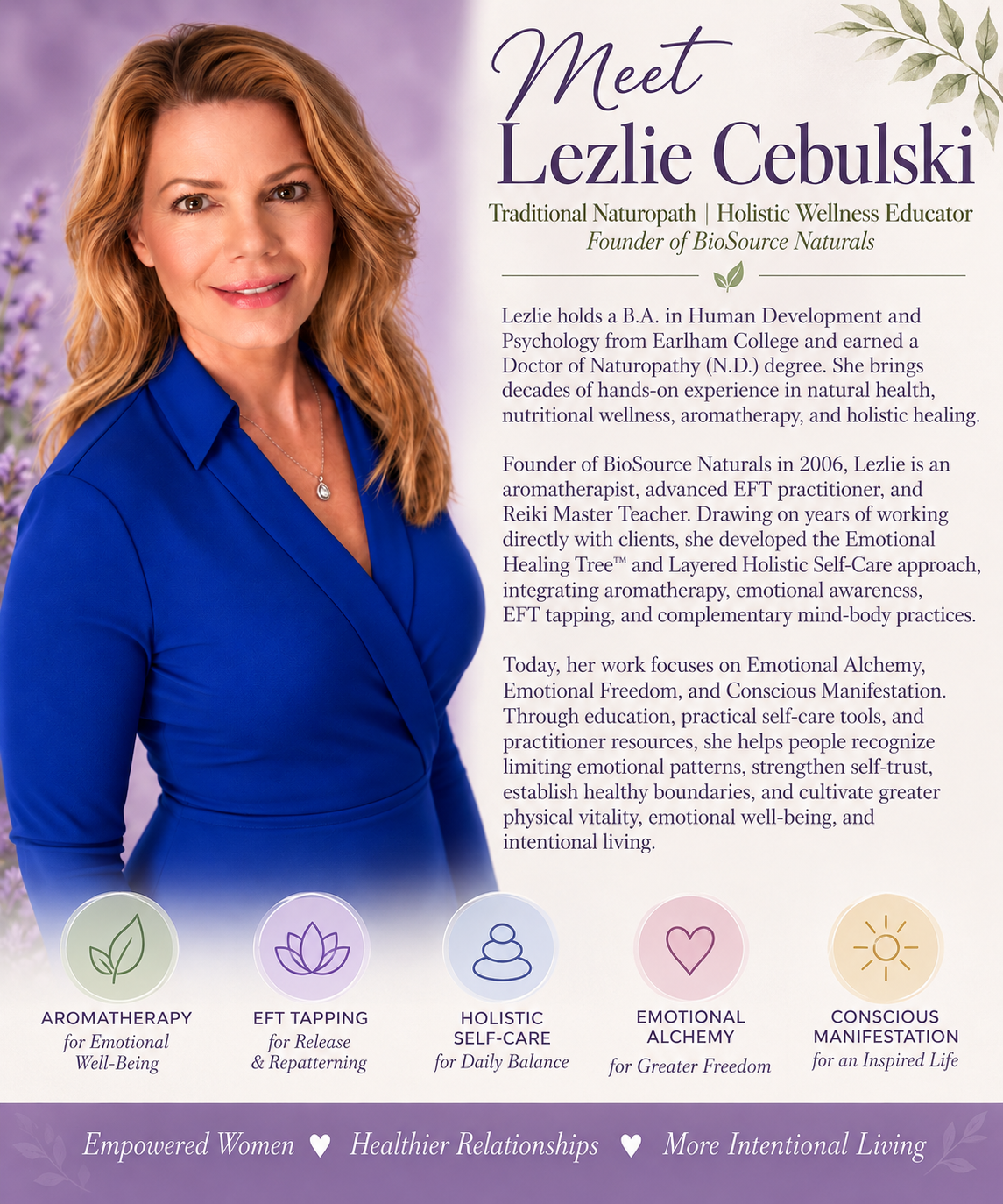
Lezlie Cebulski, N.D., EFT-ADV, Reiki Master Teacher, has been involved in health and wellness for more than 35 years, including over 15 years in private practice.
At Holistic Healing & Wellness, Lezlie combines holistic wellness education, EFT tapping, stress-management techniques, aromatherapy, mind-body practices, and personal growth strategies to help clients explore emotional patterns, develop practical self-care skills, and establish healthier boundaries.
Sessions are individualized and may address both the emotional experience of over-responsibility and its physical effects, such as tension, fatigue, and stress.
Appointments are available in New Boston, Michigan, and online.
You don’t have to wait until you’re completely exhausted to begin caring for yourself.
Schedule a free 15-minute holistic wellness consultation to discuss your concerns and explore whether working together would be a good fit.
Visit: https://holistic-healing-wellness.com/
Explore aromatherapy and self-care products: https://biosourcenaturals.com/
Holistic wellness services and aromatherapy are complementary approaches and are not substitutes for licensed mental health care or medical treatment when needed.